
The Power of Positive Affirmations and Intentions
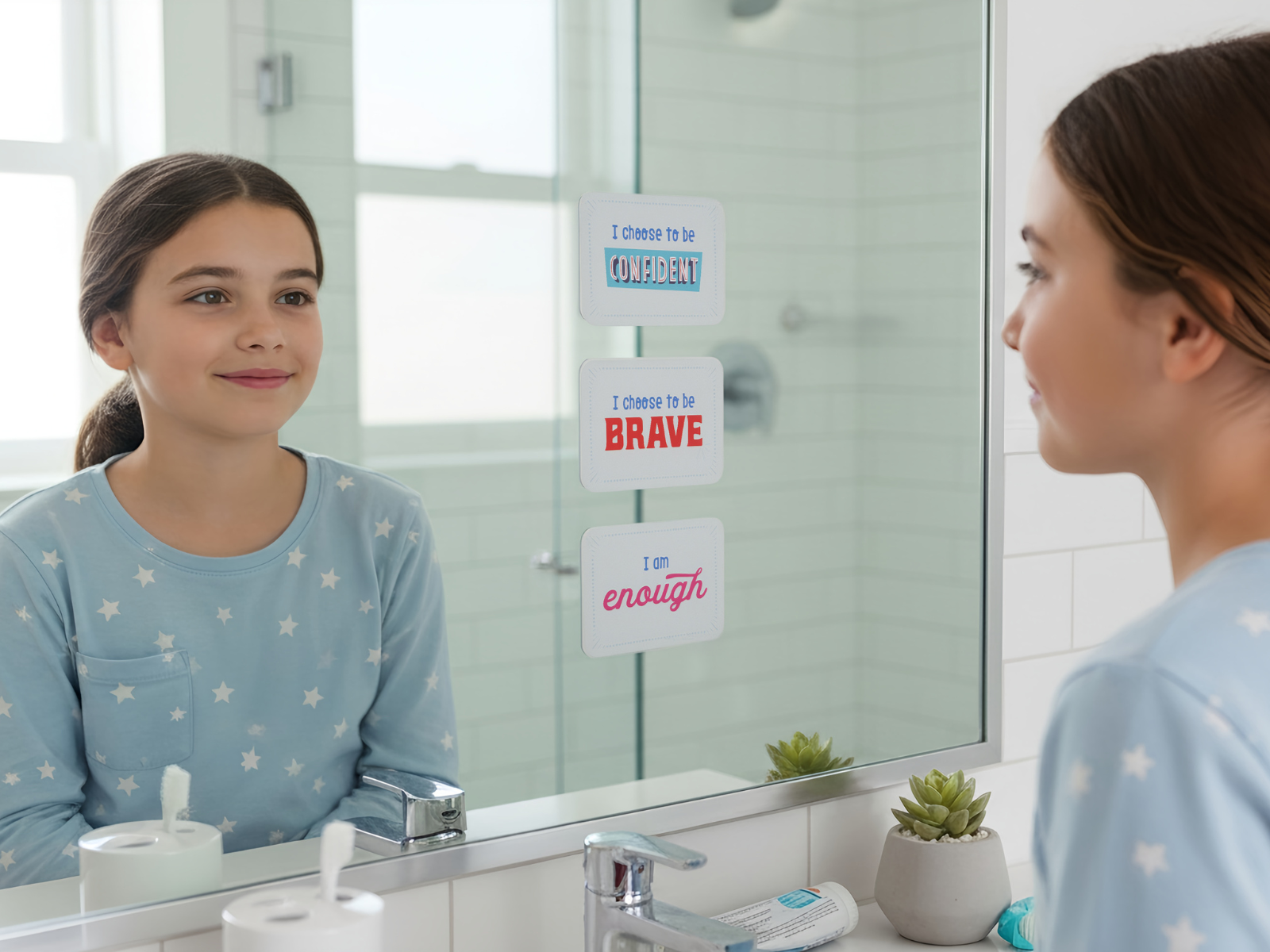
While scientists once thought the brain stopped developing in childhood, research has proven that the brain can form new neural pathways and create neurons even in adulthood. We already know that eating well, and exercising can help release feel-good hormones, and the same applies to meditation and affirmations. By creating new rituals and routines – positive daily habits – we are actually stimulating the production of new synapses.
Practising self-affirmations regularly has been proven to increase the self-esteem and confidence of users. And it’s not just about creating these positive daily habits for our children, but also carving new, stronger, and happier paths for parents too.
There’s a wealth of supporting research and evidence to support the use of self-affirmations, including decreasing stress and rumination and increasing self-belief, optimism, confidence, determination, motivation, and more.
Affirmation cards are best used in the morning, ideally soon after awaking. This is because our brains, on waking, are in Theta, or Alpha waves. These phases of brain activity are when we are most receptive to stress and anxiety reduction, when our intuition is at its strongest and when we are best aligned with our subconscious minds. In this state of mental relaxation, our unconscious mind accepts healing related statements without questions and begins to act on them immediately.
The use of such cards also helps to combat the growth of the child's ‘inner critic’. This voice of doubt tends to creep in from around the age of five and is aligned with the beginning of the deterioration of their growth mindset.
The inner critic can be incredibly harsh. And it’s rare that parents have the chance to hear what goes on in the heads of our kids. The setting of positive intentions as part of a daily ritual helps children shift negative thoughts driven by self-doubt, replacing them with statements of self-belief. When filled with self-doubt, feeling hurt, overwhelmed or challenged, Affirmations cards can be used as a remarkable tool to make fast and immeasurable positive change, shifting negative and unhelpful thoughts and feelings into positive ones.
Many parents are surprised to learn that a child’s brain is naturally wired to focus on negative thoughts. This isn’t a flaw or a failure of confidence. It is part of how the brain evolved to keep us safe. The brain’s default mode network is constantly scanning for problems, mistakes and potential dangers. While this was helpful for survival, in modern life it can become noisy and unhelpful, filling children’s minds with worries, self-doubt and “what if” thoughts.
You can help your child understand this by explaining it simply. You might say, “Your brain has a safety system that sometimes gets a bit overprotective.” Just like daydreams drift in and out without us believing they are real, negative thoughts are also just thoughts, not facts. Children often take these negative thoughts seriously and let them influence their mood and behaviour. Helping them recognise that thoughts can be questioned is a powerful first step in building emotional resilience.
This is where your affirmation cards from The Happy Confident Company can be especially effective. These cards use the phrase “I choose to be” to reinforce an important psychological message. Children are not passive recipients of their thoughts. They can actively choose how they think, feel and respond. This choice-based language supports a sense of control and self-belief, rather than encouraging children to simply repeat statements they may not yet believe.
Scientific research supports the value of affirmation practices when used regularly. Studies on self-affirmation show that reflecting on positive values and strengths can reduce stress, support emotional regulation and improve problem-solving under pressure. Research by Creswell and colleagues found that self-affirmation practices can buffer the brain’s stress response and protect performance during challenging situations (Creswell et al., 2013).
Further research reviewed by the American Psychological Association shows that brief, repeated affirmation exercises can improve overall wellbeing, reduce anxiety and support long-term positive behaviour change across different age groups (American Psychological Association, 2015).
Neuroscience research also suggests that affirmations engage brain regions involved in self-processing and reward. Functional MRI studies have shown that self-affirmation activates areas linked to positive valuation and motivation, helping reinforce healthier self-beliefs over time (Falk et al., 2015).
Using affirmation cards daily helps children practise interrupting negative self-talk and replacing it with a more helpful chosen thought. For example, reading or saying “I choose to be calm and confident” each morning strengthens neural pathways associated with emotional regulation and self-control. Consistency is key, as repetition helps the brain learn which thoughts are worth paying attention to.
Parents can support this process by pairing the cards with other small daily habits. Practising gratitude, such as sharing three good things from the day, has been shown to increase optimism and positive emotion. When affirmation cards are used alongside gratitude, children build a broader habit of noticing what is going well and recognising their own progress.
When a child says, “I’ll never get this right,” a parent can gently guide them to choose a card that reframes the thought, such as “I choose to be open to learning,” or “I choose to keep trying.” With repeated support, children learn that they are not controlled by their thoughts. They can choose how they think, feel and behave.
By consistently supporting these small but meaningful practices, parents help their children train their brains towards greater optimism, emotional balance and self-trust. Research suggests that affirmations are most effective when they are realistic, value-based and practised regularly. This makes daily use of affirmation cards a simple, evidence-informed way to support children’s confidence, resilience and overall wellbeing.
In fact, it’s scientifically proven that if we are able to identify the messages we need (in order to have increased self-belief), our brain accepts a desire to shift and is open to this belief shift. When we find the right affirmations to overrule our unhelpful thoughts and ensuing feelings, our self-belief increases, and we will more easily overcome challenges.
And while affirmations cards are most powerful when used in the morning, they can be used to refer to across the entire day. This is especially true when facing particularly challenging or testing times as they can keep us on-track and provide a dose of positivity and self-belief as and when needed.
Affirmation cards are just one of the tools The Happy Confident Company recommends using to help children (and parents) harness the in-built strength, self-belief, and determination we are gifted with from birth.